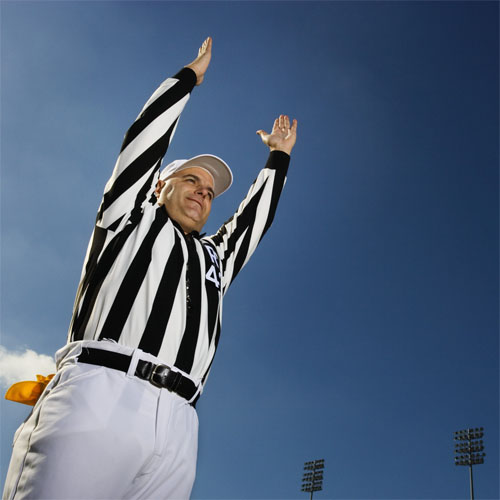
Zebra
Somewhere in, NJ
Male, 62
I've officiated football for over 30 years, now in my 26th on the college level. I've worked NCAA playoffs at the Division II and III level. In addition, I've coached at the scholastic level and have been an educator for over 35 years. I have no interest whatsoever in being an NFL official! Ever!
The ball is snapped based on where it ends up after the previous play. If the play ends outside the hash (between hash and sideline) it is brought back to the hash for the next snap. If it is incomplete, it is returned to where it was last snapped. If it ends between the hashes, it is snapped at the spit where the play ended. You don't table a choice of where to place the ball.
Share Answer: 

I have no idea what that means. Sorry, can't help.
Share Answer: 
Couple of possibilities. First, if you see the 12, you want to shut it down before the play goes off. That's the proper mechanic and the better situation. But, they simply may have still been counting (late sub, e.g.) and the ball was snapped. It's possible the player was trying to get off the field but didn't make it and the play went off. You could still shut it down but they didn't. Sometimes stuff just happens and itisn't the ideal.
Share Answer: 
Kicking cannot legally touch tbe ball until it has gone 10 yards. Yes, they can cat h it in the air but they are also subject to kick catch interference rules. The receivers can call for a fair catch.
Share Answer: 
Correctional Officer
 Were there a lot of suicides in your prison, and what's the most common way prisoners do it?
Las Vegas Cab Driver
 Do people ever ask you to keep your meter off in exchange for a cheaper fare?
Election Inspector
 Do most poll staffers agree that the ballots are REALLY confusing?
I don't know....what are they?
And what does that have to do with officiating?
Share Answer: 
Couple of things here. If the clock was running and the foul for illegal motion stopped the clock, then there could have been a 10 second runoff and the game would be over. If the click wasn't running, then yes you should have the clock reset to five seconds since the play never happened. But, and I'm not clear from your description, if the play was run and the foul was a live ball foul during the play, then you could have an untimed down or Auburn could decline the penalty and the game ends.
Share Answer: 
I wish I had seen this - it's the second question about it. Here's the answer - repeated: A player is moving forward until he isn't. If a runner collides with a teammate and falls down, he's down. Once the runner's own action stops propelling him forward - unless he runs backwards of his accord - he has ended his "forward progress". And to add/clarify: It is where the ball is when his forward movement ends, whether tackled or he falls on his own or after contact with his teammate.
Share Answer: 
-OR-
 Login with Facebook
 (max 20 characters - letters, numbers, and underscores only. Note that your username is private, and you have the option to choose an alias when asking questions or hosting a Q&A.)
(A valid e-mail address is required. Your e-mail will not be shared with anyone.)
(min 5 characters)
By checking this box, you acknowledge that you have read and agree to Jobstr.com’s Terms and Privacy Policy.
-OR-
Register with Facebook(Don't worry: you'll be able to choose an alias when asking questions or hosting a Q&A.)



 Browse Jobs
 Host a Q&A
 Search

 Submit Your Question
 Host a Q&A
 Last 7

