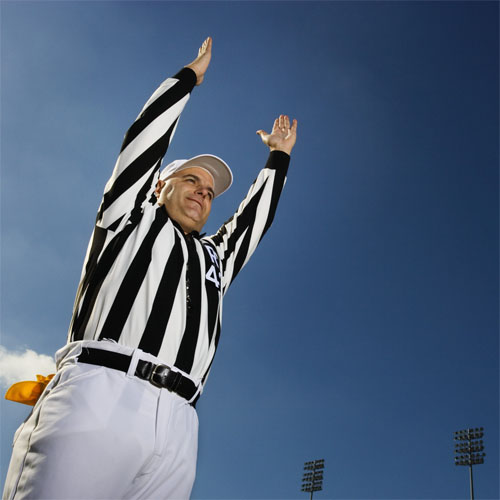
Zebra
Somewhere in, NJ
Male, 62
I've officiated football for over 30 years, now in my 26th on the college level. I've worked NCAA playoffs at the Division II and III level. In addition, I've coached at the scholastic level and have been an educator for over 35 years. I have no interest whatsoever in being an NFL official! Ever!
Really good question and my first thought was NO, but the unsportsmanlike set off bells. I decided to check anyway and I was wrong.
In the rule book, pg 76, 10-2-4, " When a team commits a non-player or unsportsmanlike foulduring that same down, it is administered from the succeeding spot as established by the acceptance or declination of the penalty for the other foul."
In the case book: pg 101, 10.4.5, situation A, B, and D.
It should be noted that the dead ball fouls they talk about are "coach coming onto the field to criticize an official, player swearing."
Share Answer: 

Yes. As long as he doesn't impede the rrceiver's opportunity to catch.
Share Answer: 
Placed at the one in the NFL, at the 2 in NCAA play. If there was a false start, then there was no play. Yes, the five-yard penalty is enforced and then the offense runs the untimed down from the 6 or 7, depending on the level. In high school, it is simply a 15 yard penalty from the previos spot.
Share Answer: 
I'm anot official, not a football historian.
Share Answer: 
Court Reporter
 If your special keyboard lets you type 200+ words per minute, why doesn't everyone use them?
Casting Director
 What do you look for when auditioning candidates for reality TV?
Help Desk Technician
 What's the closest you've come to "losing it" on someone you were helping?
Depends what you're watching. In high school, the play us dead and defense offsides us enforced. In NCAA and NFL the defender can get back before the snap. There are times when even when the player isn't threatening the QB the play is stopped. Rule of thumb: if the defender is past the shoulder of an offensive player, they'll blow it dead.
Share Answer: 
First, in the NFL, outside of two minutes remaining in each half, the clock is started once the ball is spotted after the runner goes out of bounds. And the clock is stopped when a runner goes OOB. Now, in your situation, the only thing I can think of is that Brown had forward progress and then was pushed OOB. In that case, he technically didn't go out of bounds. Rather, he was stopped while in bounds and that ended the play. Not the going OOB.
Share Answer: 
We'll only talk highvschool or college here. Simultaneous catches or recoveries go to the offense. When you say "hit the ground" you need to clarify. Catching off the ground and then returning and touching the ground with their feet? Or bodies going to the ground where the players are grounded ending the play? If they come to the ground on their feet in "joint possession", it's still a live ball and they can fight it out. If they go to the ground in joint possession, it's the offense's ball.
Share Answer: 
-OR-
 Login with Facebook
 (max 20 characters - letters, numbers, and underscores only. Note that your username is private, and you have the option to choose an alias when asking questions or hosting a Q&A.)
(A valid e-mail address is required. Your e-mail will not be shared with anyone.)
(min 5 characters)
By checking this box, you acknowledge that you have read and agree to Jobstr.com’s Terms and Privacy Policy.
-OR-
Register with Facebook(Don't worry: you'll be able to choose an alias when asking questions or hosting a Q&A.)



 Browse Jobs
 Host a Q&A
 Search

 Submit Your Question
 Host a Q&A
 Last 7

