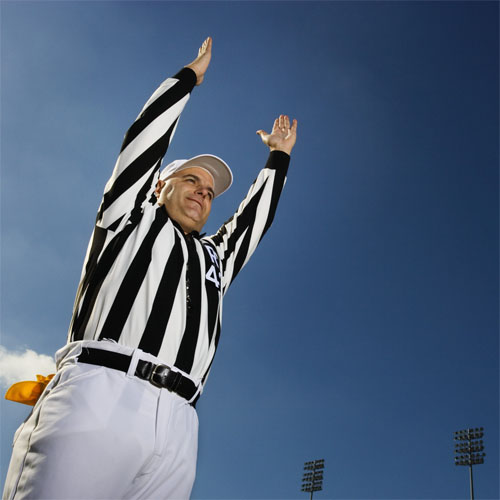
Zebra
Somewhere in, NJ
Male, 62
I've officiated football for over 30 years, now in my 26th on the college level. I've worked NCAA playoffs at the Division II and III level. In addition, I've coached at the scholastic level and have been an educator for over 35 years. I have no interest whatsoever in being an NFL official! Ever!
No one would decline the opportunity to score points. But in the case of the SupervBowl, the PAT score wasn't needed. The game had been decided. It's similar cat other levels. If the score might make a difference (e.g. as a tie breaker in league play or seeding) you have the try. If not, you can walk away...or decline.
Share Answer: 

Hmm. I'm trying to envision your play. If the ball carrier is still inside the pylon as he crosses the goal, then the ball touching the pylon makes it "in bounds" and you have a TD. But if the ball crosses the sideline before it reaches the pylon, say at the one or two yard line, then it's out of bounds and even if the player hits the pylon, with his body, the ball is out of bounds where it crossed the sideline.
Share Answer: 
Indeed it is. If the ball touches out of bounds - or anything or anybody who is out of bounds- it is out of bounds. I've actually recently heard of a coach who teaches his receivers to straddle the line (one for out) and catch the ball; that's a kick out of bounds and a foul on the kicking team..
Share Answer: 
As far as i understand, it's the same as any other play when time runs out. You continue play until the whistle. The ball is alive and in play until the play ends.
Share Answer: 
Audiologist
 How come people with hearing aids still can't seem to hear?
Audiologist
Can just one loud concert do serious damage to your ears?
Sitcom Writer
 Is reality TV here to stay?
That is,a league/ team issue, not officiating.
Share Answer: 
Good question. Are you an Ohio State or Michigan fan? The philosophy officials often use is "advantage/disadvantage". Did the action have a material impact on the play? Having an arm around a receiver isn't automatically a foul. Did the arm actually hook or grab the receiver and turn him away from the ball, or prevent him from reaching for the ball? Or was the arm being there just a good play, timed right? The rules today at virtually all levels - but especially the NFL - favor offense. So I return to the earlier point: Did the action have a material impact on the play? If yes, then we have a foul. And that's why those deep officials get the big bucks - for their judgment on that play.
Share Answer: 
The rules allow the player who "first controls the snap" to immediately throw it to the ground without being called for grounding.
Share Answer: 
-OR-
 Login with Facebook
 (max 20 characters - letters, numbers, and underscores only. Note that your username is private, and you have the option to choose an alias when asking questions or hosting a Q&A.)
(A valid e-mail address is required. Your e-mail will not be shared with anyone.)
(min 5 characters)
By checking this box, you acknowledge that you have read and agree to Jobstr.com’s Terms and Privacy Policy.
-OR-
Register with Facebook(Don't worry: you'll be able to choose an alias when asking questions or hosting a Q&A.)



 Browse Jobs
 Host a Q&A
 Search

 Submit Your Question
 Host a Q&A
 Last 7

