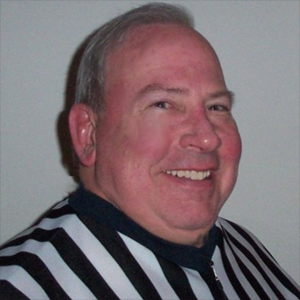
Rndballref
20 Years Experience
Chicago, IL
Male, 60
For twenty years I officiated high school, AAU and park district basketball games, retiring recently. For a few officiating is the focus of their occupation, while for most working as an umpire or basketball referee is an avocation. I started ref'ing to earn beer money during college, but it became a great way to stay connected to the best sports game in the universe. As a spinoff, I wrote a sports-thriller novel loosely based on my referee experiences titled, Advantage Disadvantage
No. In NFHS rules, a basket cannot count if an offensive foul is called on the shooter.
Share Answer: 

I think this depends on the state interpretation of its own rules. My opinion is that the player should not sit out the game after a forfeit because it is not the player's fault that a team did not show for the game of his punishment. But i see it the other too.
Share Answer: 
When a shot is released before time runs out, it becomes dead when it becomes apparent that it will not go directly into the basket. Of course, when it hits the floor it is a dead ball, and therefore does not count if it then bounces into the hoop.
Share Answer: 
No, you do not award 4 free throws in this scenario. While tehnicals count against team foul bonus totals you do not get a technical and a common foul for the same action.To illustrate, let's assume there are 8 team fouls on team b and a technical foul is called. Team a gets 2 free throws and the ball, and the bonus count goes to 9. Then on the next play team b commits a common foul. Team a shoots 2 free throws because the count goes to 10.
Share Answer: 
Casino Marketer
 What's the most unethical thing you've seen casinos do to "part you from your dollars?"
Birthday Party Clown
 OK seriously, how DOES the clown car thing work?
Wills and Estates Lawyer
 Can I leave everything to my pets?
The player needs to begin the dribble before lifting the pivot foot, so if a player jumps before dribbling he only has 2 options...shoot or pass before landing on the floor. Starting a dribble after lifting your pivot foot is travelling although not usually called in the nba.
Share Answer: 
Your question makes me think you have been tossed out of a gym and you object. Here it is in black and white.
In the NFHS rulebook, Rule 2 Officials and Their Duties, Section 8 Officials Additional Duties, Article 1, "The officials shall penalize unsporting conduct by any player, coach, substitute, team attendant or follower.In the same section under Article 1, "NOTE: The home management or game committee is responsible for spectator behavior, insofar as it can be reasonably be expected to control the spectators.The officials may rule fouls on either team if its spectators act in such a way as to interfere with the proper conduct of the game … When team supporters become unruly or interfere with the orderly progress of the game, the officials shall stop the game until the home management resolves the situation and the game can proceed in in an orderly manner."
In practice the way this works is an official notifies home management that a fan's behavior is unacceptable and the officials ask that home management eject the fan. Home management always complies because to refuse would force the official to penalize the home team starting with technical fouls potentially leading to a forfeited game. I only asked home management to throw out a handful of people in 20 years of officiating and they never refused my requests.
Share Answer: 
If the ball was established in the front court and an offensive player with ball control dribbles on the centerline or steps on any part of the centerline (while in control of the ball) it is a back court violation. The centerline is part of the back court.
Share Answer: 
-OR-
 Login with Facebook
 (max 20 characters - letters, numbers, and underscores only. Note that your username is private, and you have the option to choose an alias when asking questions or hosting a Q&A.)
(A valid e-mail address is required. Your e-mail will not be shared with anyone.)
(min 5 characters)
By checking this box, you acknowledge that you have read and agree to Jobstr.com’s Terms and Privacy Policy.
-OR-
Register with Facebook(Don't worry: you'll be able to choose an alias when asking questions or hosting a Q&A.)



 Browse Jobs
 Host a Q&A
 Search

 Submit Your Question
 Host a Q&A
 Last 7

