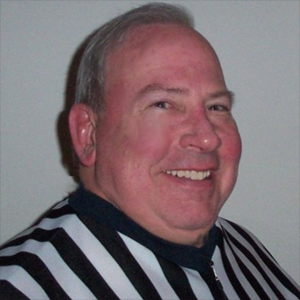
Rndballref
20 Years Experience
Chicago, IL
Male, 60
For twenty years I officiated high school, AAU and park district basketball games, retiring recently. For a few officiating is the focus of their occupation, while for most working as an umpire or basketball referee is an avocation. I started ref'ing to earn beer money during college, but it became a great way to stay connected to the best sports game in the universe. As a spinoff, I wrote a sports-thriller novel loosely based on my referee experiences titled, Advantage Disadvantage
Yes. The ref is part of the floor where he is standing. If the ref is out of bounds and the ball hits him then the ball is out of bounds. If the ref is inbounds and the ball hits him play on.
Share Answer: 

As of about 10 years ago, NFHS refs are allowed to consult with the scorer's table if they are unsure of who the foul is on, or who the shooter should be. However, it is sloppy officiating in a 3 man crew when none of the officials know who was involved in a foul. In my opinion, it is inappropriate to levy a foul based on personal foul counts. If the table knows with confidence who committed a foul then they can help. Otherwise, the official must determine who fouled, or else don't blow your whistle.
Share Answer: 
Rule 10, section 3, which delineates player technical fouls, Article 6d, "A player shall not commit an unsporting foul. This includes, but is not limited to purposely obstructing an opponent's vision by waiving or placing hands near his/her eyes."
Share Answer: 
The free throws offset. Go to the possession arrow for a half court throw in.
Share Answer: 
Veterinarian
 Do you think keeping monkeys as pets is a bad idea?
Special Education Teacher
 Should special-needs students be separated from other students?
Waitress
 What types of customers are the worst tippers?
Ok. First there is no possession on the tip. So player A1 (jumper) tips the ball - no possession. Then, the ball comes to A2 who tips the ball to B1.
If A2 tipped the ball in a controlled manner, then A2 had possession and the arrow is set to team B. If A2 did not control the ball when A2 tipped it, then team B got the first possession and the arrow is set to team A.
Share Answer: 
NCAA has a list of technicals and penalties. In NFHS rules all technicals are 2 free throws plus ball, at the mid court line. NCAA is point of interruption. It is confusing.
Share Answer: 
A ref cannot listen to a coach and do his job while a game is being played. So a ref should not respond during live balls. On the first dead ball i would approach the coach, listen to what the issue is, resolve it if legitimate, and explain that I will not listen or be interupted during live balls. If he insists on communicating while i have in game responsibilities i will consider it unsportsmanlike.
Share Answer: 
-OR-
 Login with Facebook
 (max 20 characters - letters, numbers, and underscores only. Note that your username is private, and you have the option to choose an alias when asking questions or hosting a Q&A.)
(A valid e-mail address is required. Your e-mail will not be shared with anyone.)
(min 5 characters)
By checking this box, you acknowledge that you have read and agree to Jobstr.com’s Terms and Privacy Policy.
-OR-
Register with Facebook(Don't worry: you'll be able to choose an alias when asking questions or hosting a Q&A.)



 Browse Jobs
 Host a Q&A
 Search

 Submit Your Question
 Host a Q&A
 Last 7

