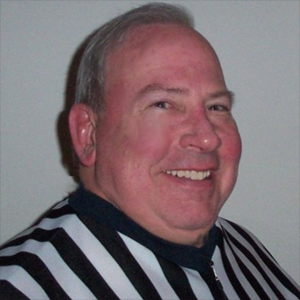
Rndballref
20 Years Experience
Chicago, IL
Male, 60
For twenty years I officiated high school, AAU and park district basketball games, retiring recently. For a few officiating is the focus of their occupation, while for most working as an umpire or basketball referee is an avocation. I started ref'ing to earn beer money during college, but it became a great way to stay connected to the best sports game in the universe. As a spinoff, I wrote a sports-thriller novel loosely based on my referee experiences titled, Advantage Disadvantage
The ref should stop the game right away if a player is injured or in imminent danger. The ref can delay the play stoppage to allow the offensive team to complete a play if there is no immediate danger to any players. The refs are also to stop play immediately if there is a vision issue such as lost contact lense or glasses knocked off someone's head.
In your situation, I would have let the offense finish the play - BUT if the offense was driving to the basket and then kicked the ball back out out to reset the play, I would have stopped the game,
Share Answer: 

Yes, in a tie game I called travelling on a last second shot which went in. I sent the game into overtime and the team that travelled lost the game.
Share Answer: 
How about a common foul after a dead ball technical? Or, a 2 shot free throw sequence where there is a violation by the defense on one of the free throws which is missed and awarded a do over?
Share Answer: 
Players should play until a whistle is blown. In your scenario the refs made two mistakes: 1) if there is not an advantage by the team in possession when the buzzer sounded, they should blow the whistle and find out what the timekeeper wanted, and 2) once they let the game continue then they should count all activities until the whistle.
Share Answer: 
Sushi Chef
 Is there a stigma against sushi restaurants that have non-Asian chefs?
Firefighter
 What kind of shape do firefighters need to be in?
Social Network Security Manager
 Can you describe the average Internet troll?
You cannot travel or double dribble on a free throw. Likewise, a player is allowed to dribble in the paint will standing behind the free throw line. Unless the count was closing in on 10 seconds, I would return the ball to the free throw shooter and start a new 10 second count.
Share Answer: 
If it is "incidental", that is if the offensive player does not gain an advantageous benefit from the contact, then I would pass on the foul. BUT, if the defender is knocked back, or his legal forward momentum is disrupted to the detriment of his defensive positioning, then it is a player control foul (formerly called "a charge."
Share Answer: 
A player must have at least one foot ON or Above a 3 foot wide (parallel to the out of bounds line) during the throw in. He/she may move forward or back all the way to the wall or bleachers perpendicular to the out of bounds line. There is no requirement to maintain a pivot foot on a throw in, nor can you travel. The violation occurs when the throw in player exits a 3 foot wide area along the boundary line before the throw in.
Share Answer: 
-OR-
 Login with Facebook
 (max 20 characters - letters, numbers, and underscores only. Note that your username is private, and you have the option to choose an alias when asking questions or hosting a Q&A.)
(A valid e-mail address is required. Your e-mail will not be shared with anyone.)
(min 5 characters)
By checking this box, you acknowledge that you have read and agree to Jobstr.com’s Terms and Privacy Policy.
-OR-
Register with Facebook(Don't worry: you'll be able to choose an alias when asking questions or hosting a Q&A.)



 Browse Jobs
 Host a Q&A
 Search

 Submit Your Question
 Host a Q&A
 Last 7

