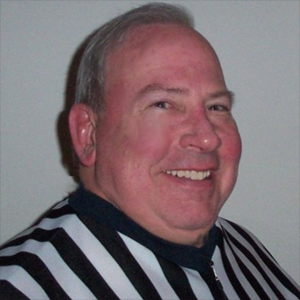
Rndballref
20 Years Experience
Chicago, IL
Male, 60
For twenty years I officiated high school, AAU and park district basketball games, retiring recently. For a few officiating is the focus of their occupation, while for most working as an umpire or basketball referee is an avocation. I started ref'ing to earn beer money during college, but it became a great way to stay connected to the best sports game in the universe. As a spinoff, I wrote a sports-thriller novel loosely based on my referee experiences titled, Advantage Disadvantage
The ball is not out bounds until it hits the floor out of bounds or a player who is out of bounds. If a player steps out of bounds and is the first to touch the ball, the other team gets a throw in. So no, a player cannot get a throw in by getting out of bounds and then getting hit with the ball.
Share Answer: 

They should not have taken the free throw away. It is not a correctable error.
Share Answer: 
Yes, he can if the arm is within his vertical space. However, once the defender pushes the arm forward and moves the offensive player (arm bar) then it is a foul,
Share Answer: 
Throwing punches is an automatic flagarant technical foul which includes ejection. However, if the other player incited the fight, such as racial slurs or unsportsmanlike conduct he could be ejected as well.
Share Answer: 
Antiques Dealer
 What's the most profit you've ever made from a single item?
Bracketologist
 Where do you think the Selection Committee needs the most improvement?
Help Desk Technician
 What's the closest you've come to "losing it" on someone you were helping?
If you catch the ball in the air, land on one foot and hop to both feet, then neither os the pivot foot. However, generally, yes. Your first foot down is your pivot foot.
Share Answer: 
No, you can never displace a player who is entitled to that space. The legal act of boxing out is continuously moving to spots before the opponent is entitled to those spots.
Share Answer: 
It should never get to this but, after a minute or two the coach should be advised that he is risking a second direct technical foul and if he refuses to sit down, he will be ejected from the gym along with that foul.
There is no time specified, but give him a moment to calm down and comply, and if necessary then t him up.
Share Answer: 
-OR-
 Login with Facebook
 (max 20 characters - letters, numbers, and underscores only. Note that your username is private, and you have the option to choose an alias when asking questions or hosting a Q&A.)
(A valid e-mail address is required. Your e-mail will not be shared with anyone.)
(min 5 characters)
By checking this box, you acknowledge that you have read and agree to Jobstr.com’s Terms and Privacy Policy.
-OR-
Register with Facebook(Don't worry: you'll be able to choose an alias when asking questions or hosting a Q&A.)



 Browse Jobs
 Host a Q&A
 Search

 Submit Your Question
 Host a Q&A
 Last 7

