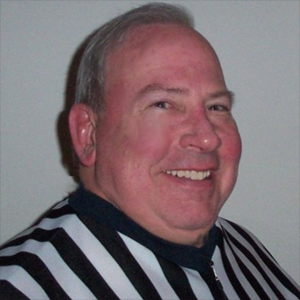
Rndballref
20 Years Experience
Chicago, IL
Male, 60
For twenty years I officiated high school, AAU and park district basketball games, retiring recently. For a few officiating is the focus of their occupation, while for most working as an umpire or basketball referee is an avocation. I started ref'ing to earn beer money during college, but it became a great way to stay connected to the best sports game in the universe. As a spinoff, I wrote a sports-thriller novel loosely based on my referee experiences titled, Advantage Disadvantage
The direction of the pivot foot vis a vis the nonpivot makes no difference as you can pivot 360 degrees on your pivot. If your right foot is the pivot you can step with your left and then jump picking up your right foot off the floor and it is legal. I think of it this way - if you were not allowed to ever lift your pivot foot how could you shoot a layup? Direction does not matter, you can make this move as a fadeaway and it is still not travelling (but your coach might bench you!).
Share Answer: 

When the ball goes through the basket it is a dead ball and anyone can call timeout until the team takes possession (even after a made basket by your team while on offense, until your opponent picks up the ball).
After the first of 2 free throws there will not be team possession, so either team can call time out until the ball is at the disposal of the shooter for his second free throw.
Share Answer: 
OK. Got it. A player with the ball could push, hold, slap, trip, and charge for player control fouls. A team mate of the player with the ball could do the same plus illegal screens. All of these are control fouls with no free throws.
Share Answer: 
Placing the ball on the floor repeatedly denies the other team the opportunity to grab the ball and run. Here's how it should be handled. After the second occurence, the ref should stop the game and issue a "delay of game warning" against the team, and ask the scorer to register a warning in the book.. If they do it again, the offending player should be charged with a technical foul.
Share Answer: 
Audiologist
 Are earbuds dangerous for my ears?
Court Reporter
 If your special keyboard lets you type 200+ words per minute, why doesn't everyone use them?
Literary Scout
 Can a novelist achieve huge success through self-publishing?
According to theriches.com beginning NBA referees make $150,000 and senior officials make up to $550,000. In every game, one official is designated as the "referee" and the others are "officials". In NFHS, the referee has certain additional duties such as picking who will toss jump balls, giving pre-game instructions etc.. But the "referee" is not supposed to overrule the other two officials. I suspect that in the NBA, senior officials might have additional duties such as travel arrangements, meetings, training, rule advisories, etc.
Share Answer: 
Other than technical fouls, there are no free throws awarded when a team with possession of the ball commits a foul.
If it is in the possession of the player committing the foul, then it is a player control foul (NO free throws). If a player's team has possession and a foul is committed by a player on that team without the ball it is a team control foul (and again, NO free throws).
A team or player control foul is never awarded free throws, and it makes no difference if the team is in bonus.
Also, you might be asking if a charge is the only player control foul possible? The answer is no. A player with the ball might push, trip, hold, etc a defensive player and an offensive player without the ball might set an illegal screen, push, hold, etc in addition to charging. All of this is relative to NFHS rules.
Share Answer: 
In youth basketball it is common to be biased against the biggest kids. It is unfair, but it happens. If there is a silver lining it is that your son will be well prepared for AAU and high school rough play. Although unfair, it is better for your son to toughen up then for him to not develop because he is currently bigger than his teammates. Read the book, "Play Their Hearts Out" for a real story of the next LeBron who was the best player in the country in middle school, but flattened out at 6'2" as a senior in high school.
Share Answer: 
-OR-
 Login with Facebook
 (max 20 characters - letters, numbers, and underscores only. Note that your username is private, and you have the option to choose an alias when asking questions or hosting a Q&A.)
(A valid e-mail address is required. Your e-mail will not be shared with anyone.)
(min 5 characters)
By checking this box, you acknowledge that you have read and agree to Jobstr.com’s Terms and Privacy Policy.
-OR-
Register with Facebook(Don't worry: you'll be able to choose an alias when asking questions or hosting a Q&A.)



 Browse Jobs
 Host a Q&A
 Search

 Submit Your Question
 Host a Q&A
 Last 7

