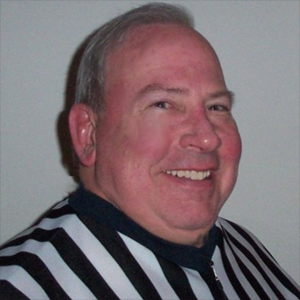
Rndballref
20 Years Experience
Chicago, IL
Male, 60
For twenty years I officiated high school, AAU and park district basketball games, retiring recently. For a few officiating is the focus of their occupation, while for most working as an umpire or basketball referee is an avocation. I started ref'ing to earn beer money during college, but it became a great way to stay connected to the best sports game in the universe. As a spinoff, I wrote a sports-thriller novel loosely based on my referee experiences titled, Advantage Disadvantage
I played in men's leagues until about 10 years ago. Being a ref gives you a unique perspective and helps your game. But like all good things they come to an end. I am recently retired from officiaiting (and quit ballin about 10 years ago).
Share Answer: 

1) it is ok for a player to do a layup with a bent knee UNTIL the knee contacts a defensive player who has obtained legal guarding position. 2) It is ok for a player to bend over into a space UNLESS the offensive player contacts an opponent who has legally obtained legal guarding position. 3) There is no such rule as over the back (this is a pet peeve of mine). It is perfectly legal for an opponent to leap high enough to reach over the top of a player as long as no illegal contact is made. When the game announcer tells the fans that an "over the back" foul was called he really should be saying "there was a pushing foul, or illegal use of hands", but you will not find in the rule book over the back or reaching in.
Share Answer: 
Of course. Common sense dictates that a referee should not distract any players. But there is a large grey area. How about a referee who "talks" players out of three seconds violations, or a referee who verbally counts to 5 seconds on a throw in (proper mechanics call for a hand count, not verbal) or a referee who yells "hands off" to avoid calling a hand check. Some people say each of these acts represents inappropriate coaching - others say each one is good "preventive officiating".
In my opinion, verbally saying "foot on the line" is beyond mechanics and unnecessary.
Share Answer: 
If there is a violation on the first of two free throws, the first free throw is whistled dead and unsuccessful and the the second free throw will be administered. So, no the violation on the first free throw does not cancel the second.
Share Answer: 
Bowling Alley Attendant
 What do bowling alleys do to keep those nasty shoes clean/sanitary?
Hotel Travel Blog Active 2019
 What do you do if a guest is doing something illegal in a room?
Track and Field Coach
 Do you let your athletes play another sport in the off-season?
The ball is NOT out of bounds when it crosses the imaginary plane above the sidelines or end lines. The ball is out of bounds when it touches an object or player or other person who is out of bounds. So if Team A's player leaps in the air from in bounds, crosses thru the imaginary boundary in the air and does not touch anything and saves the ball by hitting onto a Team B player who is standing out of bounds, the ball should be awarded to Team A. However, if Team A's player is the last to touch the ball before it hits something out of bounds beside a player on Team B (such as the bleachers, or an out bounds referee, or the bench, or the part of the floor which is out of bounds), then Team B gets the ball.
Share Answer: 
see answer above.
Share Answer: 
Let me guess ... you were sarcastically clapping at the ref's call that fouled you out? Sounds like a thin-skinned official!
In NFHS rules a disqualified player must remain on the bench or be sent to the lockerroom with supervision. So, while on the bench it is possible to receive a T. Not only is the player assessed with a T, but the coach is assessed with an indirect T.
Share Answer: 
-OR-
 Login with Facebook
 (max 20 characters - letters, numbers, and underscores only. Note that your username is private, and you have the option to choose an alias when asking questions or hosting a Q&A.)
(A valid e-mail address is required. Your e-mail will not be shared with anyone.)
(min 5 characters)
By checking this box, you acknowledge that you have read and agree to Jobstr.com’s Terms and Privacy Policy.
-OR-
Register with Facebook(Don't worry: you'll be able to choose an alias when asking questions or hosting a Q&A.)



 Browse Jobs
 Host a Q&A
 Search

 Submit Your Question
 Host a Q&A
 Last 7

