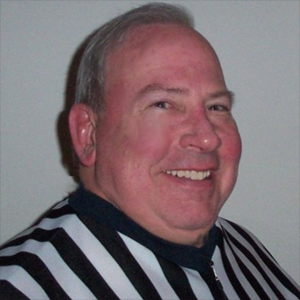
Rndballref
20 Years Experience
Chicago, IL
Male, 60
For twenty years I officiated high school, AAU and park district basketball games, retiring recently. For a few officiating is the focus of their occupation, while for most working as an umpire or basketball referee is an avocation. I started ref'ing to earn beer money during college, but it became a great way to stay connected to the best sports game in the universe. As a spinoff, I wrote a sports-thriller novel loosely based on my referee experiences titled, Advantage Disadvantage
In theory, swatting a defender's arms is a violation. If a defender has the right to a space, swatting his arms is a foul. But if the defender is handchecking (or forearm checking) an experienced ref would either call a foul on the defender, or not call anything. Instead he could warn both players to keep their arms off each other. Unfortunately, often the offensive player gets caught swatting because the ref missed the initial armcheck.
Share Answer: 

The placement of a throw in after a time out is the same as the placement after a violation or a non-shooting foul. The spot should be perpendiclar to nearest sideline oe endline. So imagine a diagonal line from the elbow of the free throw line to the corner of the sideline/endline. If the ball was on the sideline area of that line then find a perpendicular line to the sideline. If it is on the other side of the diagonal then the ball goes to the endline. If the ball was in the paint, then it is taken out on the endline at the closest line of the paint - never on the endline directly under the basket.
Share Answer: 
If the ref calls for the ball you should give it up. If you defy the ref it could be construed as disrespectful by a thin-skinned official. So yes, it could be called. BUT I never have made that call and I advise refs not to.
Share Answer: 
yes.
Share Answer: 
Special Education Teacher
 How come it often takes years to figure out that a kid is dyslexic?
Veterinarian
 Do you think keeping monkeys as pets is a bad idea?
McDonald's Manager
 Were you proud or embarrassed to tell people you worked at McDonald's?
The rules states that a player cannot be in the paint for 3 or more seconds, so technically when you get to three it is a violation. HOWEVER, as I have stated before I rarely called 3 seconds. 1) I tried to talk players out, and 2) it is the perfect advantage disadvantage call. That is I only called it when it made a difference tp the play - for example a player getting an offensive rebound after camping out.
Share Answer: 
The jurisdiction of the officials ends when the score is approved and the referees leave the visual confines of the court. Each state decides, with bylaws, what penalties will be assessed for player and coach ejections. There is no rule or penalty in the NFHS rulebook that an official can assess after a game is over. So the official should write up a game report and send it to the state (or league) for further adjudication.
Share Answer: 
The ball is still inbounds, unless the player who is out of bounds touches the ball. So, in your question, assuming the out of bounds player is not touching the ball ... PLAY ON!
Share Answer: 
-OR-
 Login with Facebook
 (max 20 characters - letters, numbers, and underscores only. Note that your username is private, and you have the option to choose an alias when asking questions or hosting a Q&A.)
(A valid e-mail address is required. Your e-mail will not be shared with anyone.)
(min 5 characters)
By checking this box, you acknowledge that you have read and agree to Jobstr.com’s Terms and Privacy Policy.
-OR-
Register with Facebook(Don't worry: you'll be able to choose an alias when asking questions or hosting a Q&A.)



 Browse Jobs
 Host a Q&A
 Search

 Submit Your Question
 Host a Q&A
 Last 7

