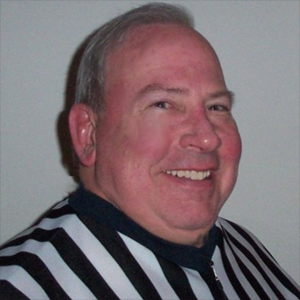
Rndballref
20 Years Experience
Chicago, IL
Male, 60
For twenty years I officiated high school, AAU and park district basketball games, retiring recently. For a few officiating is the focus of their occupation, while for most working as an umpire or basketball referee is an avocation. I started ref'ing to earn beer money during college, but it became a great way to stay connected to the best sports game in the universe. As a spinoff, I wrote a sports-thriller novel loosely based on my referee experiences titled, Advantage Disadvantage
Doesn't sound like a correct call. The violation should have been ignored OR a pushing foul should have been called.
Share Answer: 

This is a close one. Who is entitled to a space on the floor? Answer: the player who gets there before another player leaves his feet to get to the same space. If in your example the defender is "riding" your backside in lockstep towards the basket, each of you are entitled to the straight line toward the endline. So unless either player leans into the other and dislodges, I would say incidental, legal contact.
Share Answer: 
No, the points should not be cancelled because the free throw ended "when it is certain the try was unsuccessful". The points were scored after the free throw ended, but before the error was recognized. When you are able to correct an error, "points scored, consumed time and additional activity, which shall occur prior to the recognition of an error shall not be nullified.
Share Answer: 
I did not see the play, but you are quite right that if a player is out pf bounds (any part of his body is touching the line or beyond the line) and he touches the ball, it should be whistled out of bounds and a throw in awarded to the other team.
Share Answer: 
Toll Collector
 What happens when a car blows past a tollbooth without paying?
Call Center Representative
 What is the meanest thing a caller has ever said to you?
Mailman (City Letter Carrier)
 Are postal workers more disgruntled than other workers?
There is no provision in NFHS rules for a running clock. Club or AAU traveling rules may allow for a running clock.
Share Answer: 
Actually, a dribble ends when you put two hands on the ball. But even if you have not dribbled already, putting two hands on the ball on the floor is normally called double dribble.
Share Answer: 
The buzzer does not make the ball dead. Players should play on until they hear a whistle. Once possession has been established or the basket made the refs should blow the whistle, stop play and check with the timer to find out why the horn sounded.
Share Answer: 
-OR-
 Login with Facebook
 (max 20 characters - letters, numbers, and underscores only. Note that your username is private, and you have the option to choose an alias when asking questions or hosting a Q&A.)
(A valid e-mail address is required. Your e-mail will not be shared with anyone.)
(min 5 characters)
By checking this box, you acknowledge that you have read and agree to Jobstr.com’s Terms and Privacy Policy.
-OR-
Register with Facebook(Don't worry: you'll be able to choose an alias when asking questions or hosting a Q&A.)



 Browse Jobs
 Host a Q&A
 Search

 Submit Your Question
 Host a Q&A
 Last 7

