Factor
Woodstock, VA
Male, 65

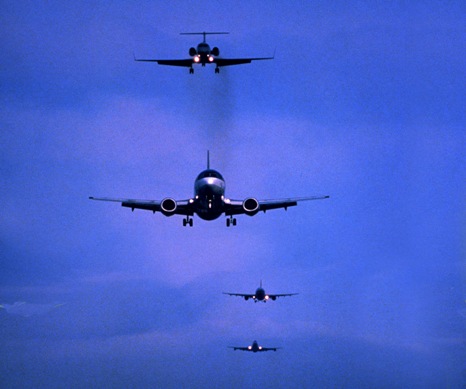
My life in ATC began with 4 years Air Force then another 30 years with the Federal Aviation Admin. working tower & radar at some big international airports. I fought in the 1981 war with PATCO, survived the strike and kept a job that was just too exhilarating to walk away from. While there was nothing better than working airplanes, I did move on through several air traffic supervisory and management positions. It was a long, crazy career but I wouldn't trade a moment of it for love or lucre!
Hello “No. 1 Uncle,” and a happy 4th back at you! I hope you enjoyed a fabulous fireworks display.
In order to obtain a permit for public fireworks displays, the organizers must obtain approval from the Federal Aviation Administration. Any conditions the FAA imposes must be followed in order to receive that permit. The FAA then makes the information on such events available to those who need to know.
I can’t say there have never been aircraft accidents due to fireworks displays. Using absolutes like “always” or “never” tend to get me into trouble. I’ll just say I don’t recall hearing of any and that makes sense to me. After all, aeronautical charts clearly indicate minimum safe altitudes (MSA) to fly at. Planes rarely operate below the MSA unless they are taking off or landing. It’s a pretty safe bet your FAA won’t approve fireworks displays near an airport, along those departure or arrival paths. Besides, fireworks don’t go much higher that a few hundred feet. Certain flights do operate at those altitudes but only during daylight hours; a bad time for fireworks. These planes are involved in such things as crop-dusting, banner towing, aerial photography or some other low altitude mission.
I hope this answers your question. Thanks for writing!
Factor
Share Answer: 

Thanks for writing Isaac. The answer to your question is no! There are radar blind spots all over the continental U. S. The good news is that, as a pilot or passenger, you don’t have to worry about it too much. The blind spots are generally at very low altitudes and there are pilot/controller procedures used in the non-radar environment to keep aircraft safe from other airplanes and the terrain. Around airports where most commercial flights operate and at the altitudes they cruise at, radar coverage is continuous – unless one of the radar sites is not working (it happens). In such cases, those pilot and controller procedures I just mentioned come into play.
Even though an aircraft is below radar coverage, the pilot has several options to maintain flight safety. When weather conditions permit; pilots can visually separate themselves from obstructions such as mountains, antennas or power lines. If pilots cannot maintain good flight visibility, there are usually instrument procedure available that keep the airplanes safely above such obstructions and guide them to their destination.
Radar is a wonderful tool for both controllers and pilots but it has its limits. The radar pulses travel outbound from the antenna in ‘line-of-sight’ fashion. If there is an obstruction in the way of the beam (for example; a mountain or cityscape) the beam will go no further in that direction, at and below the height of the obstruction. It will, however, continue to travel in that direction above the obstruction. So...if you had a radar system in your front yard; your house would prevent you from seeing radar targets in the back yard but you would still get a radar image of the plane flying above your house.
I hope this answers your question!
Cheers,
Factor
Share Answer: 
Hello Jim! Thanks for bringing up a very important issue. Whether pilot or controller; thunderstorms are the bane of their workday. All three factors you mentioned can affect the safety of flight. Lightning can be pretty disconcerting but not as dangerous to an airplane as you might imagine. Today’s planes are given extensive lightning certification tests to ensure the safety of their design. That could be why the last commercial plane crash attributed to lightning happened in 1967.
The lack of visibility, although a hazard in some instances, is not a major problem for pilots flying in or near thunderstorms. Rather than looking out the cockpit windows, they’re normally relying on the aircraft’s flight instruments to keep it properly oriented.
By far, the biggest safety hazard relates to the tricky winds found in and around those things! Accident investigation reports are rife with accounts of what can happen when airplanes experience the vertical wind shears and microbursts associated with thunderstorms (See Eastern Airlines Flight 66 landing JFK in 1975 or Delta Flight 191 landing DFW in 1985 as examples). Especially hazardous when planes are operating near the ground (taking off or landing), such winds can cause the aircraft’s wings to lose the lift they need to maintain flight. If this happens to a landing airplane (and it can happen instantly), all the available engine power may not be enough to save it.
When a plane loses the lift needed to maintain flight it becomes more like a brick that someone has thrown. It may still be traveling forward but only due to forward momentum and only for a very short time. I saw this happen from one of the control towers I worked in. An airliner flew through a thunderstorm situated on the final approach course and turned into that “brick” within a mile of the runway. When I finally saw the plane; it was no longer really flying but wallowing left and right as it fell. Fortunately, it fell onto the grass adjacent to the runway and eventually slid to a stop. The aircraft was destroyed but incredibly, there were no fatalities. I’ll tell you though; my shift couldn’t have ended fast enough.
Thank you for writing,
Factor
Share Answer: 
Thanks for writing, Doctor Hank. I’m glad you caught me during office hours. You’ve raised some great questions but, unfortunately, I don’t make house calls.
In fact, I was trained in stress management and the ways of coping with pressure - but the FAA didn’t provide this training. They did, however, provide the learning environment. Our primary means of dealing with pressure was simply understanding that nearly everyone else on the crew was dealing with it too – perhaps even simultaneously. There was a strong team “will” to meet and defeat the challenge. No one had to face the dragons alone and knowing that made a big difference.
Then, after those dragons were dispensed with, we’d all come together for the best kind of therapy we knew. We’d meet at our favorite after-work bar and rehash the shift’s best and worst moments in a non-judgmental environment. As you know; talking about your issues with others who have been through the same thing is both calming and cathartic. As a result; we’d usually show up for our next shift - free of regret, revitalized and ready to do it all over again.
Everyone had their own individual ways of coping with pressure; some more obvious than others. As a floor Supervisor, you’d learn to recognize the signs that a controller was feeling the squeeze. A change in body posture, pumping a leg, drumming fingers, changes in voice level, cursing or throwing things were a few of the more obvious signs. Others were more subtle but a good Supervisor knew them all and acted quickly to assist.
One thing we all tried not to do during periods of high stress was to imagine the number of lives in our hands and the consequences if something went wrong. Stuff like that is distracting and will quickly throw your whole game off.
As to the ability to handle pressure being factor in hiring controllers; I cannot speak for FAA's current policies. I can say that, during my career, there was no reliable way of assessing a potential new employee’s strength in that area. Everyone, including the new employee, had to find out during their first few dips in the crucible. Some did the backstroke and others burned up. Going into the profession, I doubt that many people know how they’ll react when the vise begins to close. I sure didn’t. Although their coworkers may notice some early indicators; most controllers don’t recognize that emotional squeeze until it’s too late. Robert Burns nailed it when he wrote; “O would some power the giftie gie us to see ourselves as others see us.”
Thanks again,
Factor
Share Answer: 
Hollywood Executive Assistant
 Does your boss ever have you lie on his behalf?
Magician
 What's the most amazing magic trick you've ever seen?
Border Patrol Agent
 Do Mexican authorities help on THEIR side of the border?
Hi there, “ATC Wannabe.” I really hate it when I can’t answer a reader’s question but just going to have to buck up and admit defeat. I have no idea what O”Hare or the Great Lakes Regional Office’s hiring policies are. O”Hare Airport is within The Great Lakes Region’s authority. As in the previous reader’s question, I recommend you call the Great lakes Region when you are ready and ask them about ATC job openings. I also recommend you take your friend’s opinion as well intended but likely to be uninformed. As a “high schooler” – you have plenty of time to position yourself as a viable ATC candidate - anywhere.
As to the idea of starting your career off in one of the many busy facilities; there are differing opinions. The skeptics and those motivated by ego will say you must be an experienced and exceptional controller before setting foot in the door. While I understand their argument I disagree. Having started my own FAA career in a very busy facility, I can attest to the benefits of learning how to handle complex and heavy traffic conditions right off the bat. I also know that, later in my career, when I was training folks who transferred in from less active facilities, it was hard breaking them of their more laid back work habits. When you start off in a busy place, you learn to work quickly and efficiently. Plus; the steady pace of traffic makes for more frequent and meaningful training opportunities. This is something the smaller facilities can’t always provide.
I’m happy to hear of your enthusiasm for air traffic control and wish you all the best in your pursuit of a career.
Cheers,
Factor
Share Answer: 
I think I can help you James. I’ll tell you a story that isn’t really fiction but it’s close enough to fool most anyone.
The scene was a fairly large airport located somewhere North of Florida. Characters in this story included a team of tower controllers plus several local and Federal law enforcement officials. One of them had called the control tower and advised the supervisor that they had been tracking a suspected drug smuggling plane ever since it left Central America several days prior. It was expected to land at this airport very soon. The Agent was very specific in his instructions to the tower supervisor. When this flight checked in with the tower, controllers were to act as normal as controllers can possibly act. As if that wasn’t difficult enough, there were additional instructions.
Upon landing, the plane was to be guided to a specific parking area on the ramp, where extensive preparations had been made to arrest the crew. The supervisor briefed his controllers, who immediately grew excited by the idea of taking part in a drug bust! The excitement intensified with each passing minute. Eventually, the airplane did call the tower for landing instructions. All seemed normal as the plane landed. There were no signs the pilot was suspicious as the tower controller instructed the flight to contact Ground Control.
Now, we were all sure that the “preparations” must have looked like a scene out of Miami Vice; with walkie-talkies crackling away in everyone’s ear, snipers hidden in the shadows and a dozen SWAT Team guys, dressed in black and ready to storm the plane. We all watched as it taxied off the runway toward the parking area.
The ground controller appeared a little nervous but responded promptly and professionally when the suspect aircraft called him. After all; this was his moment to shine – his 15 minutes of fame! The response he gave would become permanently ensconced in local ATC folklore. Remembering everything he’d been told about the situation by his supervisor (but apparently forgetting the part about why), he instructed the pilot to “Taxi to the Northeast corner of the ramp. The Federal agents are waiting to meet you there!”
The plane made a quick turn back onto the runway and accelerated. It lifted off, leveled at crop dusting altitude and vanished quickly over the horizon. Nobody heard whether the pilot was ever caught but the tower supervisor sure was. Within minutes, the cab was full of astonished and very irate agents who had brought with them a huge headache for that supervisor.
Thanks for writing and have fun with your fiction.
Factor
Share Answer: 
Howdy Arizonagirl13 and welcome to my tiny piece of Jobstr real estate. Looks like it’s time to pay the rent! You’ve posed an excellent question and I’m hoping my answer will keep me from being evicted.
Although it is true that English is recognized worldwide as the language of air traffic control, I am sure there are occasional deviations. Pilots in non-English speaking countries who fly in and out of airports that handle only regional traffic probably converse with controllers in their native language. Why not? Their home language is familiar to all concerned, so there is less chance for any misunderstandings. I’ve worked as a controller at a foreign airport and know this to be true. However, if one of those pilots had to use an airport that handled flights from other countries; that pilot had better be familiar with the jargon of ATC in English. The same principle would apply if an English speaking pilot arrived at a foreign, regional airport. The controllers there would be expected to do their work in English.
If pilots and controllers are not on the same page (language-wise), chaos can quickly gain momentum. The foreign airport I mentioned above was actually a joint-use military base and a glaring exception to the ATC language standards. Our tower was staffed with both American and locally grown controllers. The locals were responsible for any flights operated by pilots of their own nationality; using their native language. We worked all our traffic in English. As if that wasn’t chaotic enough, there was an interpreter in the tower, who’s job it was to keep each set of controllers advised about what was going on. Without someone with knowledge of both languages to translate, neither side knew what the other was doing. Unfortunately for all of us, our interpreter was about as helpful as a rodeo clown in a slaughterhouse. Inattentive, lazy and frequently absent, we all learned to work around him and deal with the mayhem on our own. All that to say that clear communication between everyone involved in maintaining safety of flight is essential; no matter what part of the planet the planes are flying in.
Thanks for writing and I hope my answer was helpful.
Cheers,
Factor
Share Answer: 
-OR-
 Login with Facebook
 (max 20 characters - letters, numbers, and underscores only. Note that your username is private, and you have the option to choose an alias when asking questions or hosting a Q&A.)
(A valid e-mail address is required. Your e-mail will not be shared with anyone.)
(min 5 characters)
By checking this box, you acknowledge that you have read and agree to Jobstr.com’s Terms and Privacy Policy.
-OR-
Register with Facebook(Don't worry: you'll be able to choose an alias when asking questions or hosting a Q&A.)



 Browse Jobs
 Host a Q&A
 Search

 Submit Your Question
 Host a Q&A
 Last 7

