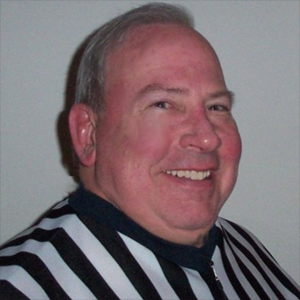
Rndballref
20 Years Experience
Chicago, IL
Male, 60
For twenty years I officiated high school, AAU and park district basketball games, retiring recently. For a few officiating is the focus of their occupation, while for most working as an umpire or basketball referee is an avocation. I started ref'ing to earn beer money during college, but it became a great way to stay connected to the best sports game in the universe. As a spinoff, I wrote a sports-thriller novel loosely based on my referee experiences titled, Advantage Disadvantage
In NFHS all flagrant fouls (personal or technical) result in 2 free throws plus the ball at half court. In addition, the player charged with a flagrant foul is immediately disqualified. You never shoot 1 and 1 on a flgrant foul.
Share Answer: 

I call it bad preventative officiating. One of the officials should count the players after each time out, and prevent the play from starting until you have ten players on the floor. However, once the play starts the fifth player cannot come back in until there is a dead ball whistle.
Share Answer: 
Carrying the ball is one of ways the rule book states that a dribble comes to an end. So the very next dribble should be called as a double dribble if the player carried the ball prior to the subsequent dribble. My opinion is that refs have allowed too much carrying to go on - the dribbler gains too much control of the basketball if you let a player cup or turn over the ball.
Share Answer: 
Rule 6 Section 3 Article 3... Teammates shall not occupy adjacent positions around the center restraining circle if an opponent indicates a desire for one of these positions before the referee is ready to toss the ball.
Share Answer: 
iPhone & iPad Technician
 What brand do you think has the poorest quality / workmanship?
Birthday Party Clown
 OK seriously, how DOES the clown car thing work?
Firefighter
 What kind of shape do firefighters need to be in?
There are five correctible errors in the NFHS rulebook: 1) failure to award a merited FT, 2) awarding an unmerited FT, 3) permitting the wrong player to shoot a FT, 4) attempting a FT at the wrong basket, & 5) Erroneously counting or cancelling a score. Unfortunately in your scenario, the error was in announcing 2 free throws (he never progressed to awarding the erroroneous 2nd freet throw). So, the error is not correctible, the basket counts, and now belongs to the opposing team. Tough break because of bad officiating.
Share Answer: 
No, by rule they cannot, but it depends (and the following discussion assumes the offensive player does NOT have the ball):
Coaches teach the armbar technique but if the arm in the back prevents an offensive player from moving to another legal spot, it is holding.
If the armbar is set within the verticality the defender is entitled to, and the defender's forearm is used to keep from being pushed backward by the offensive player then there is no foul, or an offensive foul.
I always looked to see if the armbar moved foreward to push the offensive player off his spot, then it is a foul. If the armbar did not push the opponent, I would not call it
Share Answer: 
The answer is yes. A rule change for this coming season (2014-15) in NFHS rules states: Arm sleeves, knee sleeves, lower leg sleeves and tights are permissable as long as they meet the color and logo restrictions.
Share Answer: 
-OR-
 Login with Facebook
 (max 20 characters - letters, numbers, and underscores only. Note that your username is private, and you have the option to choose an alias when asking questions or hosting a Q&A.)
(A valid e-mail address is required. Your e-mail will not be shared with anyone.)
(min 5 characters)
By checking this box, you acknowledge that you have read and agree to Jobstr.com’s Terms and Privacy Policy.
-OR-
Register with Facebook(Don't worry: you'll be able to choose an alias when asking questions or hosting a Q&A.)



 Browse Jobs
 Host a Q&A
 Search

 Submit Your Question
 Host a Q&A
 Last 7

